The St. Lawrence River originates as the outflow of the Great Lakes, transforming into a vast estuary near Ile d’Orléans and ultimately expanding into the Gulf of St. Lawrence at Point-des-Monts. This waterway encompasses nearly 1,200 kilometers of navigable waters, serving as a crucial conduit that connects the Great Lakes and the heart of North America to the Atlantic Ocean. It plays a pivotal role as an essential artery for Canada’s economy and supply chain.
One notable challenge faced by the region is the occurrence of ice jams, particularly in the Lake St. Pierre section downstream from Montréal. These ice jams have the potential to obstruct commercial navigation, leading to floods that can result in significant damage. Lake St. Pierre denotes the widening of the St. Lawrence River between Sorel and Trois-Rivières, constituting the upstream segment of the river’s estuary. The water depth in this area is generally shallow, except within the navigation channel, where it is maintained at a minimum of 11.3 meters below chart datum. Due to lower water velocity and the presence of curves in the channel, this section is more susceptible to ice congestion compared to other parts of the river.
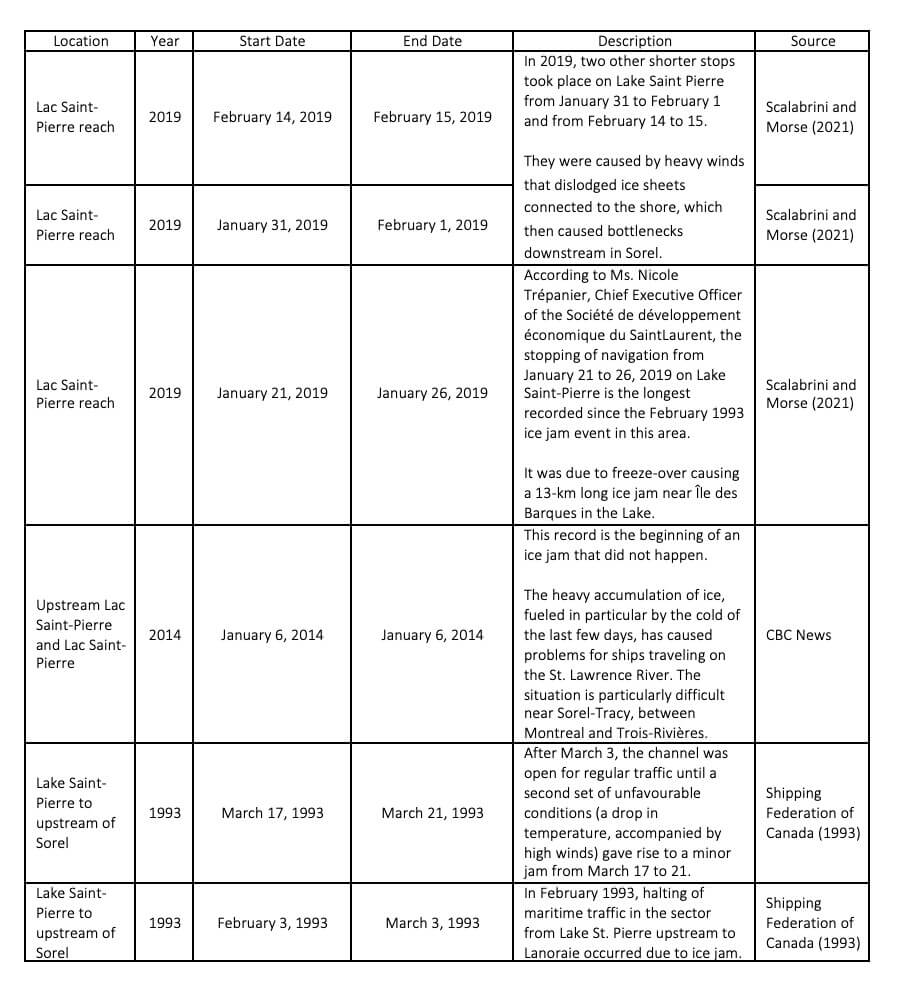
Since 1993, there have been at least six recorded instances of ice jams in this area (refer to Table 1). The initial ice jam event in 2019 resulted in the suspension of domestic and international ship operations for over a week. Additionally, it led to a 25-centimeter rise in water levels near Contrecoeur and caused “vessel clogging” following the release of the ice jam.
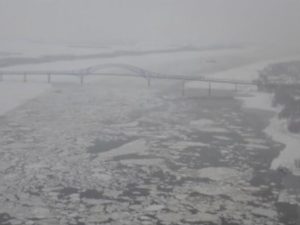
Table 1. Ice jam events near Lake St. Pierre from 1993 to 2019Figure 1. The St. Lawrence River near Trois-Rivieres on Saturday, Jan. 26, 2019. Photo by Alexandra Cournoyer/Environment CanadaGSTS has undertaken the development of a comprehensive ice management capability that has successfully amalgamated and analyzed ice and environmental conditions in its AI powered proprietary platform, OCIANATM. These factors play pivotal roles in the occurrence of ice congestion. The innovative capability comprises an artificial intelligence (AI) powered ice concentration prediction model and an analytical ice jam warning model.OCIANATM offers early warnings up to seven days in advance, effectively mitigating the potential impacts of ice jam events.
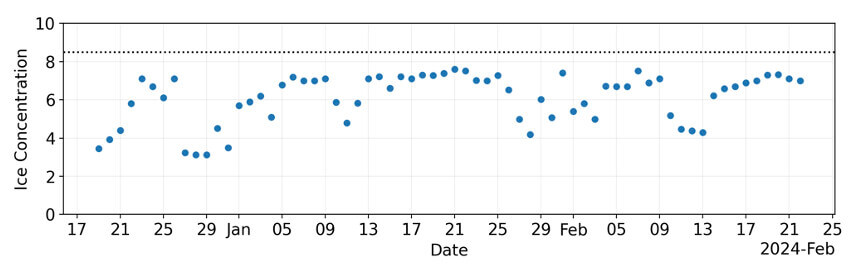
Figure 2 illustrates the forecasts of ice concentration in Lake St. Pierre spanning from December 19, 2023 to February 22, 2024, generated by the AI prediction model. No ice jam risk warnings were issued by the analytical model throughout this specified time period, aligning with the fact that no actual ice jam occurred. This outcome underscores the effectiveness and reliability of the developed models. The successful implementation of this advanced capability marks a significant stride in enhancing the proactive management and reduction of risks associated with ice congestion in crucial sections of the St. Lawrence River.
Figure 2. Ice concentration prediction of Lake St. Pierre from the AI model from December 19, 2023 to February 22, 2024The inception and implementation of the ice jam prediction capability yields numerous advantages for all stakeholders relying on the St. Lawrence River for navigation.These encompass enhancements to planning capabilities concerning ice congestion, enhanced communication to terminal operators regarding potential delays, refined route planning for incoming vessels, improved resource planning for tugs engaged in ice breaking assistance, heightened effectiveness of ice breakers, and an overall improvement in operational efficiency that diminishes the risk of shipping delays and accidents.
Importantly, the methodology and models integral to the ice jam prediction capability are versatile and can be tailored for application in other regions susceptible to ice congestion risk. This adaptability opens the door for the potential expansion of this innovative capability to address challenges in areas such as the Great Lakes and the Arctic, further contributing to safer and more efficient navigation in regions prone to ice-related disruptions.






 English