The grey zone refers to a contested operating space where state and state-backed actors conduct coercive activities below the threshold of armed conflict. These actions are deliberate, strategic, and designed to alter the status quo, such as asserting control over disputed waters or resources without triggering a conventional military response.
From a defence standpoint, the defining feature of grey zone activity is ambiguity as a weapon. Actors frequently leverage civilian or commercial vessels to maintain plausible deniability, complicating attribution and delaying response decisions.
Key takeaways
- Grey zone activity thrives on ambiguity. State and state-backed actors increasingly use civilian vessels, deceptive behaviours and legal mechanisms to pursue strategic objectives without crossing the threshold of conventional conflict.
- Maritime security requires more than vessel tracking. AIS alone cannot provide a complete picture when vessels can disable, manipulate or spoof their identities. Effective monitoring requires multiple data sources and persistent surveillance.
- Critical infrastructure and trade routes are increasingly exposed. Coercive maritime activity can threaten access to resources, disrupt shipping and create risks for subsea cables, pipelines and other critical infrastructure.
- Deterrence depends on early detection and rapid attribution. Persistent maritime awareness, allied information sharing and the ability to identify and expose suspicious activity can help authorities respond before situations escalate.
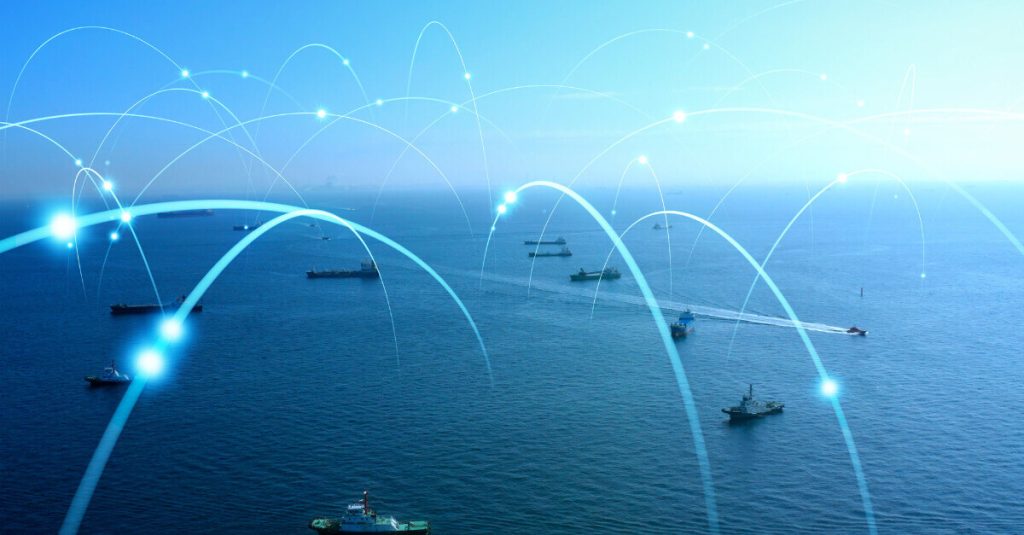
- AI and multi-sensor intelligence can illuminate the grey zone. Combining AIS, satellite imagery, radar, RF data and behavioural analytics can help distinguish normal maritime activity from anomalies, identify dark vessels and provide actionable insight into developing risks.
Why maritime grey zone activity matters
Grey zone operations pose a direct and growing threat to the rules-based international order and maritime security architecture. Their impact is strategic, not tactical.
Key defence implications include:
- Resource Denial – Adversaries use coercive presence to restrict access to fisheries, hydrocarbons, and seabed resources.
- Trade Route Vulnerability – With global trade heavily dependent on maritime routes, persistent disruption increases risk exposure, insurance costs, and supply chain fragility.
- Critical Infrastructure Risk – Critical underwater infrastructure, like subsea cables and pipelines, are increasingly targeted through covert interference or disguised “accidents,” threatening both energy security and global communications.
Common grey zone tactics at sea
Grey zone actors deliberately blend into normal maritime traffic, masking coordinated operations as routine activity.
Typical behaviours include:
- Maritime Militias – State-aligned “civilian” fleets used to assert presence, harass vessels, and occupy contested areas.
- AIS Manipulation – Disabling Automatic Identification Systems (AIS), spoofing location data, or frequently changing vessel identity to evade detection.
- Swarming Tactics – Deploying large numbers of small vessels to overwhelm targets or deny access to strategic locations.
- Lawfare – Exploiting legal frameworks and domestic legislation to legitimize unlawful claims and constrain adversary responses.
Deterrence in the grey zone
Traditional deterrence models are insufficient in the grey zone. Instead, defence strategies must focus on deterrence by denial to reduce the likelihood that grey zone operations will succeed.
Core defence measures include:
- Operational Transparency – Publicly exposing malign activities using verified intelligence to impose reputational and diplomatic costs.
- Persistent Maritime Presence – Maintaining continuous naval and coast guard operations to assert control and deter harassment.
- Allied Integration – Enhancing intelligence sharing, joint exercises, and coordinated responses to close operational gaps.
- Rapid Attribution Capability – Accelerating the ability to identify and publicly attribute grey zone actions to responsible actors.
Technology as a force multiplier
Effective maritime grey zone defence requires persistent, multi-domain awareness. Advanced technologies play a decisive role in detecting, attributing, and countering covert maritime activity.
Key capabilities include:
- Remote Sensing Intelligence – Integration of Synthetic Aperture Radar (SAR), optical imagery, and radio frequency (RF) detection to track vessels operating without AIS.
- Behavioural Analytics and AI – Establishing baselines of normal maritime activity and identifying anomalies that signal coordinated or pre-operational behaviour.
- Uncrewed Systems – Autonomous surface and subsea platforms enabling continuous surveillance in contested or high-risk areas without escalating political risk.
How OCIANA® supports grey zone monitoring
OCIANA® is a maritime AI-enabled platform specifically engineered to provide the high level of maritime situational awareness required to counter grey zone tactics.
OCIANA® supports maritime security through several key capabilities:
- Multi-Sensor Data Fusion:The platform ingests and correlates real-time data from multiple sources, including satellite AIS, radar, and optical sensors, to create a single, validated operational picture.
- Dark Vessel Detection:By comparing satellite imagery with AIS transmissions, OCIANA® identifies “dark” vessels attempting to evade surveillance, a hallmark of grey-zone activity.
- Maritime Risk Assessment: OCIANA® uses machine learning to identify ships within an area of interest and assess their risk status based on movement history and behavioural patterns.
- Predictive Insights:Beyond simple tracking, the platform provides predictive analytics for equipment maintenance and vessel logistics, ensuring that naval and coast guard assets maintain the operational readiness needed for persistent presence in contested waters.
By leveraging OCIANA® platform, national and international agencies can transform massive datasets into actionable intelligence, effectively illuminating the grey zone and protecting maritime sovereignty. Contact us to learn more about how OCIANA® can help you monitor your maritime grey zones.
Contact us to learn more about OCIANA®
FAQs
Grey zone warfare is a strategy built on incrementalism, often described as “salami slicing.” An aggressor takes small, calculated steps that do not individually warrant a declaration of war. Over time, these actions accumulate to create a significant strategic advantage.
This method relies on hybrid threats, blending non-military levers like economic pressure, cyber operations, and disinformation with physical presence at sea to confuse and paralyze an opponent’s decision-making process.
Grey zone operations are designed to stay below the threshold of armed conflict, making it difficult to justify military escalation while still causing strategic harm.
Not always. Many actions exploit legal ambiguities or loopholes, making them difficult to challenge under existing international law.
By focusing on improving detection, increasing transparency, maintaining presence, and coordinating with allies.
They provide plausible deniability, allowing states to avoid direct attribution while still exerting influence.
Technology enables persistent monitoring, anomaly detection, and faster attribution, all of which are critical for timely and effective response.
Yes. As direct military conflict becomes riskier, more states are turning to grey zone methods to achieve strategic objectives without escalation.
Gradual erosion of sovereignty, normalization of coercive behaviour, and weakening of the rules-based international order.
It increases operational uncertainty, raises insurance costs, and can disrupt key maritime chokepoints and supply chains.




 English